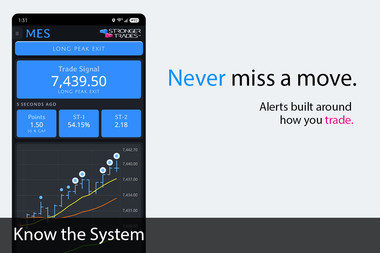
The market doesn't wait for you. Alerts make sure you don't have to wait for it either.
Most traders feel like they have two options: stay glued to the screen and catch everything, or step away and miss something important.
Alerts exist to give you a third option. Stay connected to what matters without sacrificing everything else in your day to do it.
You Have a Signal
When momentum on a symbol reaches the level you've set, the platform calls for you. Audibly. Unmistakably. You have a signal.
It's become the voice of the platform. And like the best notification systems, it doesn't just inform you. It orients you. By the time you're back at the screen, you already know something worth looking at is happening. You're not scrambling. You're ready.
Your System, Your Rules
Every trader has a different relationship with noise. Some want to know the moment anything starts moving. They'd rather evaluate more alerts and never miss an early opportunity. Others want the market to prove itself first. They're not interested in every ripple. They're waiting for the wave that's worth their full attention.
The alert system accommodates both, and everyone in between. Each symbol has its own threshold you control independently. The platform's standard baseline is tied to ST-1, the signal strength indicator. Pull that threshold down and you hear about moves earlier, while they're still developing. Push it up and the system stays quiet until momentum has built into something real.
And because it's per symbol, your setup can be as nuanced as your trading. The instruments you watch most aggressively can be set to call you in early. The ones where you prefer to wait for stronger confirmation can be set higher. Two traders watching the same four symbols can have completely different alert experiences, because the system is built around what each of them is actually looking for.
Think of it like surfing. Some traders want to know about every wave as it forms and make the call at the water's edge. Others are waiting for the big one. They've told the system what size wave justifies their attention, and everything below that stays quiet until the right one arrives.
The result is an alert system that works the way you work, not the other way around.