There is no standard tool for this.
This might surprise you. The futures industry has no shortage of platforms, indicators, and data feeds — but when it comes to answering the most basic question a trader faces every morning, the industry has largely left traders to figure it out on their own.
The question is simple: Is today worth trading?
The answer, for most traders, is a patchwork.
What Experienced Traders Actually Do
Ask a seasoned futures index trader how they decide whether to engage on any given day, and you'll get some version of the same fragmented routine:
They check the economic calendar. FOMC days, CPI releases, jobs reports — high-impact events either keep experienced traders out entirely or become the trade itself. Either way, knowing the calendar is table stakes.
They look at the overnight range. If ETH has already run hard in one direction, the regular session may have nothing left to offer. A market that's already extended rarely gives clean follow-through.
They check the VIX. Low volatility often means calm, narrow-range sessions — small moves, tight bars, little room to work with. Not necessarily choppy, but thin, and often not worth the risk of committing capital.
They watch pre-market volume on ES or NQ as a rough proxy for participation. Thin participation means thin opportunity.
Some use ATR to estimate whether the expected daily range even justifies the risk of putting on a trade.
None of this is wrong. These are legitimate inputs used by experienced traders who have spent years learning what to look for. But there are two problems with this approach.
First, it's fragmented. The economic calendar is one tab. The VIX is another platform. Volume data is somewhere else. Piecing it together takes time and discipline that newer traders often don't have yet.
Second, it's experience-dependent. Knowing what a low VIX usually means for the day ahead is knowledge you earn — often by losing money on thin sessions first. There's no dashboard that synthesizes these signals into a readable picture of the day's structure before you commit.
That gap is real. And it has a cost.
The Question Nobody Has Built a Tool Around
Most trading tools are built around how to trade — which direction, which levels, which setup. Very few are built around whether to trade at all.
That's not a minor oversight. For index futures traders — especially those trading Micros or managing limited capital — a bad-condition day isn't just a missed opportunity. It's drawdown. It's frustration. It's the kind of experience that erodes confidence and distorts a trader's read on their own edge.
The newer the trader, the harder this problem is. An experienced trader has enough pattern recognition to walk away from a thin, low-conviction open. A trader six months in doesn't have that reference library yet. They see price moving and they engage — because the tools they have tell them what's moving, not whether it's worth moving with.
What a Consolidated View Actually Changes
The Live Session Report was built to answer this specific question — not after the fact, but in real time, before you commit.
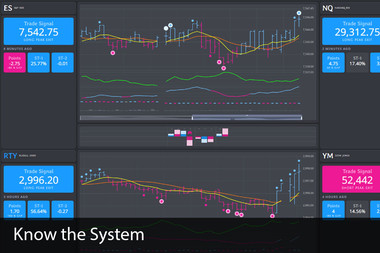
Twelve instruments. One table. Trade Runs, Strong Runs, Signal Count, ST-1 strength, and session progress across ETH, Asian/London, and RTH — all updating live as the session develops.
The difference between this and the patchwork approach isn't just convenience. It's signal quality. When you can see that ES has high signal count but low Trade Runs, you know it's a noisy day — price is moving but not resolving. When you see Strong Runs climbing and ST-1 Avg rising across multiple instruments, you know structure is building. That's not an interpretation you have to construct from five different sources. It's visible in one view.
The economic calendar still matters. The VIX still matters. But those are context. What the Live Session Report gives you is current condition — what is actually happening in the market right now, measured against how these instruments normally behave.
That's what experienced traders are trying to reconstruct manually every morning. It's what newer traders don't yet know how to reconstruct at all.
Most traders guess whether today is worth trading.
They don't have to.