Most traders cycle through their charts one at a time. By the time they've made the rounds, the moment they were looking for has already passed.
The Signal Page and the Trade GRID were built to solve that problem.
The dashboard is entirely browser-based. No software to install, no plugins, no desktop application. Navigate to the page, and you're already connected. The system knows who you are and what you have access to.
The Signal Page — Full Depth on One Symbol
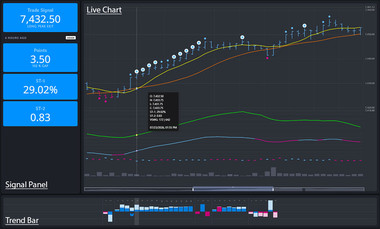
When you want to focus, the Signal Page gives you everything you need on a single instrument in one place. The signal panel, the Trend Bars, and the chart are all connected, not just displayed together but actually linked. Mouse over any point in the Trend Bar and the chart moves with you, showing the exact price action that produced that moment in the trade. Nothing is isolated. Everything talks to everything else.
What that means practically is that you're never trying to piece together what happened from separate sources. The full story of the trade, where it started, how it developed, what the signals looked like along the way, is right there, connected and in sync.
The Trend Bar also carries history. Previous trades are visible within it, and you can load up to 10 trades at once. That context matters. Knowing what the market was doing before the current signal appeared changes how you read that signal, and that changes the quality of your decisions.
The Trade GRID — Four Instruments, One Screen
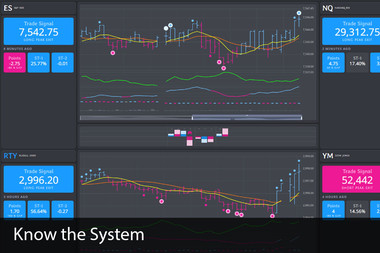
The Trade GRID takes that same connected experience and expands it across four related instruments simultaneously. Same signal panels, same Trend Bars, same live charts, multiplied across an entire family of instruments and all updating together in real time.
The instruments are organized into three families:
- Micro Equity Indexes — MES, MNQ, M2K, MYM
- E-mini Indexes — ES, NQ, RTY, YM
- U.S. Treasury — TU, FV, TY, US
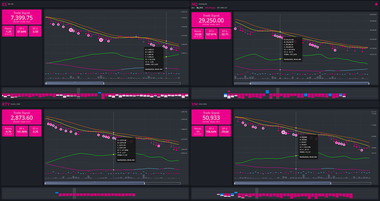
Here's why that matters. Related instruments don't always move together. On any given day the NASDAQ might be pushing while the S&P lags. The Russell might be stalling while the Dow leads. When you're watching one symbol at a time, you see fragments of a picture. On the GRID you see the whole thing.
And when all four instruments in a family start moving in the same direction at the same time, that convergence is one of the most significant events in futures trading. It signals that something real is happening, not just noise in one corner of the market. The GRID puts that moment in front of you as it's building, not after it's already resolved.
That's the difference between reacting to the market and being ready for it.